
Post-quantum readiness for AWS, Azure and Google Cloud: CMS Quantum
Find the cryptography in your cloud. Plan the move to post-quantum.
- Status
- In development
- Runs on
- AWS, Azure, Google Cloud
- For
- Organisations running on AWS, Azure or Google Cloud
Know where the cryptography in your cloud is, how ready it is for post-quantum, and what to change first, without your findings leaving your cloud.
- 01
Discover
Every crypto object in the estate: keys, certificates, secrets and the algorithms a configuration allows. Each one is placed on one ladder, from weak to post-quantum, and what cannot be judged is marked unknown rather than guessed.
- 02
Score
A readiness score worked out by a published method, version 3, with the weight of every category written down. It never runs higher than the share of the estate a scan could read, and both numbers are shown.
- 03
Plan
A migration plan with one item per change, dated by the obligations each one is in the way of, and a readiness briefing in six short parts for the board.
The dates
The NCSC has set the timetable
Three dates, and the first of them starts with knowing where your cryptography is.
- By 2028
Discovery and an initial plan
Define your migration goals, find what depends on cryptography, and plan the move.
- By 2031
The highest-priority migration
The early, most important changes made, and the plan turned into a full roadmap.
- By 2035
Everything migrated
All systems, services and products moved to post-quantum cryptography.
Timelines for migration to post-quantum cryptography, NCSC
Published 20 March 2025 · checked
Cryptography by level
One ladder for every crypto object
Weak, standard, strong, hybrid or post-quantum. Not applicable and unknown are levels of their own, so nothing it cannot judge is rounded up to look better.
573 crypto objects across 3 environments
Demo data- Weak today
- 38
- Weak on 1 January 2031, if nothing changes
- 450
The projection uses the dates the level definitions set for the end of 2030. Where a date rests on a draft source, the objects it moves are counted as provisional.
The readiness score
A score with its working shown
An indicator of posture, not an assurance of security. The method is published, and every score carries the version of it that worked the score out.
Five categories, method version 3
A category with nothing in it to judge is left out, and the others make up the whole.
How much a finding counts, by priority
Critical100%
High60%
Medium30%
Low10%
The method's own example: 200 keys judged, 10 with a high finding and 40 with a medium one. That costs 10 × 60% + 40 × 30% = 18 of 200, or 9 points, and the category scores 91.
Never higher than what it could read
Posture 93 · capped at 87% covered
The method's own example: 30 parts to a scan, 24 finished and 4 refused some of what they asked for. The covered proportion is (24 + 4 × 50%) ÷ 30 = 87%, so a posture of 93 is reported as 87, and both are shown. Accepting a risk never raises the score.
For the board
A readiness briefing in six short parts
Worked out from the same scans as everything else, so the board and the engineers are reading one set of numbers.
- 01
The readiness score, and how it moved
- 02
Cryptography by level
- 03
What binds the organisation
- 04
The migration plan, in totals
- 05
What to do first
- 06
What the briefing does not cover
What it does
Everything in CMS Quantum today
Listed because it exists in the build, not because it is on a roadmap. Anything still being written is described as such in the words further down, never as a line in this list.
It finds the cryptography
You cannot plan a migration from an inventory you do not have, so the first job is to read what is there.
Every crypto object, by level
Keys, certificates, secrets and the algorithms a configuration allows, each placed at weak, standard, strong, hybrid or post-quantum. Not applicable and unknown are levels of their own, so nothing is rounded up.
Three clouds, one inventory
AWS, Azure and Google Cloud, read through connections that can look and cannot change. A Terraform module deploys it on each.
Read-only, and the build checks it
A read-only proof and a manifest of the permissions it asks for are checked in CI on every change, rather than promised on a page.
Where it would stand on 1 January 2031
The same objects projected to the start of 2031 if nothing changes, once the dates set for the end of 2030 have passed, so the size of the job is visible before the deadline is.
It scores readiness, and shows its working
A score you cannot check is a score you have to take on trust. This one is written down, weight by weight, and every score says which version of the method worked it out.
Five categories, published weights
Algorithms 25, transport security 25, certificate hygiene 20, keys and stored data 20, and agility 10. A category with nothing in it to judge is left out, and the others make up the whole.
Capped by what it could read
The score cannot exceed the covered proportion: the share of each scan that finished. Granting what a scan was refused is how you raise the cap.
Accepting a risk never raises it
An accepted risk still counts against the score. It is recorded, not forgiven.
By application and by team
Scores worked out by the same method for each application and each team, from the tags already on your resources.
It plans the move
Readiness is only useful if it turns into work somebody can schedule.
A migration plan, dated by obligation
One item per change, with the findings that change fixes, dated by the obligations it is in the way of, and in the order the work can be done in.
How hard each change is
Agility sorts the changes into easy, moderate and hard, so a setting that one person can change is not planned like a key that six systems share.
A supplier register
Your vendors, each with how ready it is for post-quantum cryptography and why: ready, on track, at risk or not known.
A readiness briefing for the board
Six short parts: the score and how it moved, cryptography by level, what binds the organisation, the plan in totals, what to do first, and what the briefing does not cover.
Why this one
What is true here that is not true elsewhere
Your findings never leave your cloud
The instance runs in your own account. The CMS control plane issues licences and signed updates, and never holds your findings, inventory, asset names or configuration.
It says what it could not see
Every score is shown beside the share of the estate a scan could read, and is never higher than it. A scan that was refused something lowers the cap rather than quietly scoring what it found.
The method is versioned
Every score carries the version of the method that worked it out. When the method changes, earlier scores keep the numbers they had, and the trend says where part of a change is the method's.
Who it is for
Organisations that run on AWS, Azure or Google Cloud and have been told, by a regulator, a customer or their own board, to know where their cryptography is and to have a plan for moving it to post-quantum algorithms.
The NCSC’s timeline asks for that discovery and an initial plan by 2028, the highest-priority migration by 2031, and the whole of it by 2035. The first of those is a year and a bit away, and it starts with an inventory of where your cryptography is. Our guide sets out what each of the three dates asks of you.
How it works
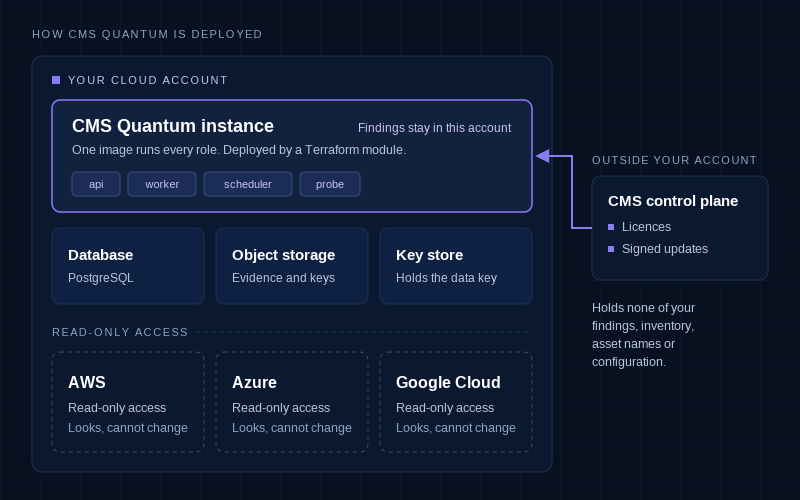
One instance is deployed into your own cloud account with a Terraform module, next to its own database, object storage and key store. It reads your estate through read-only connections, judges each crypto object it finds, and keeps what it finds where it found it.
Nothing about your estate is sent to us. The CMS control plane outside your account sends in two things, a licence and signed updates, and holds none of your findings, inventory, asset names or configuration.
When you can get it
CMS Quantum is in development. There is no listing to link to and nothing to deploy yet, and plans and prices have not been set. If you would like to hear when it is ready, write to hello@cmsinfosec.com.
Being clear about it
What CMS Quantum is not
Said plainly here, so nobody has to find it out after they have chosen it.
- It does not change anything in your cloud. It reads, and the build checks that reading is all it can do.
- The readiness score is an indicator of posture, not an assurance of security, and not a certification.
- It does not migrate anything for you. It says what to change, in what order, and by when.